Saturday, March 28, 2009

Day Three ---- Zion to Tucson


Well. From Tucson, its only an hour to the Border. The dreaded border! I think CNN probably has a dramatized name for it by now, "The Border of Death," or some such thing. As it turns out, its all media hype. There is a wave of drug crime in Mexico, assinations, and murder, but not really random, or directed at tourists. Its more a a war, than crime and its a targeted war between the cartels and other cartel and the government.I woke up super early this morning to make it out the canyon before sunrise to watch the light come down on the the Court of the Patriarchs. I'll let the pics speak for themselves. Then is was more driving down through Vermillion Cliffs, and past the head of the Grand Canyon, and across the Painted Desert. I ran into a real dust storm in this area. At one point I had to slow to a crawl on the highway because the visibility was zero. I really really really do not like dust storms. My trusty steed the A6 sustained some damage in this bout. Tiny, scrathes to the windshield. Very sad. But, its nothing that I notice when I'm not being a hypocondriac, so I'll just keep on driving. I spend the night in a hotel in Tucson. A luxury after the dust of my various campsites.

Drivin Day Two

Day two was Utah. Warm. Mormons. Tract housing and huge, beautiful mountain ranges. Distant fires or.... dust? Yes. Maybe distant dust storms on the other end of the black rock desert.

I ended the day camped in Zion National Park. Here the moutains and canyon become truly breathtaking.

Drivin South


Day one I drove from Benton City, WA to Willard, UT. Great driving. A little boring. Amazing scenery. But it takes a while to get to you! Northeast Oregon is amazing and unheralded. There are some high and snowy mountains there. I got in the bad habit of taking photos out the window. Here's some of the results.


That night I camped in between Great Salt Lake and I-84 in a smoky campgound filled with Mormon boy scouts. Utah has amazing scenery and equally mesmerizing religious insanity going on. You can just feel it in the air. Like the dust.

Roadtrip South

Well. igoogle weather is telling me that its 35 degrees and raining in Seattle. I'm happy to report that sounds very strange and distant from my current reality. Every day is in the upper seventies and it cools of to 60 at night. I'm in San Carlos, Sonora, Mexico, where Sula has sat patiently in the desert for over a year, waiting to set her keel back in the brine again. I drove down here from Seattle. A great trip. I'll now go back in time and lay out some of the highlights

Tuesday, October 7, 2008

Secondary Fermentation

Neighborhood Vineyard 2008 Syrah ended its primary fermentation last week. Primary ends when the yeasts eat up all the available sugars and the must becomes "dry." Our consulting winemakers (Brent&Sarah) told me that its not the best practice when making Syrah to let the wine sit on the skins for too much longer than necessary as it makes the wine more tannic and can impart more bitter flavors. So Christophe used a collander and a potato masher to squash our mixture of fermented skins and juice into a steel keg. The wine is now, actual wine, very harsh and tart with a yeasty smell and taste from the recently completed fermentation. It also has a milky white color, reminiscent of a glacial river, which I imagine is dead yeast cells still in suspension.


Now that the wine has been pressed off into the keg, it will be allowed to sit for many months and the expended yeasts and any solids settle out to the bottom. This layer of sediment is known as the lees, and will not be disturbed when the wine is siphoned out of the keg and into bottles. The wine will now undergo secondary fermentation in the keg. Also known as malolactic fermentation, this process was jumpstarted by a second innoculation of a special bacteria which insure a quick start to the process. Malolactic fermentation is another biologcial/chemical process where malic acid is converted to lactic acid, which happens to be much easier on the palatte. Cheap wine is normally allowed so sit in large stainless steel tanks while it undergoes secondary fermentation, and often chips of oak wood are added to impart oak flavors to the wine. More expensive wine spends this part of its life in large oak barrels. Since out batch is so small, we've dispensed with the barrel and used some of Brent and Sarah's excess and experimental oak balls which should add a bit of the normal oak flavor. So now its time to wait and let the wine slowly mature and soften and become not just drinkable but enjoyable.


We started out with 150 lbs of grapes. Which made a must of approx 14 gallons. Now the wine is down to j. That comes out to about 25 bottles of wine. Which is roughly 3 grape vines per bottle of wine. At each step in the proces the wine becomes more of a mysterious and precious commodity. I'm now beginning to understand how a truly remarkable bottle of wine is the final step in a long laborious process that started years ago in the vineyard and could have met with disaster at almost any step of the way.

Sunday, September 21, 2008

Winemaking - Day 2


Sarah and Sarah watch the yeast come alive before innoculation.


The yeasts are set free into their playground.

Brent and Sarah Goedhart are my invaluable mentors, and have a well oiled operation producing a few hundred cases of their own Red Mountain Syrah. They have generously taken a few minutes from their busy crush schedules to assist our small science project. Day two in the life of a wine seems an important one. B+S measured the sugar content of our must on the morning of the second day and found that the Brix (sugar) was 26.3, which could result in a very high alcohol wine, and so we added 1.2gallons of water to aim for a final alcohol content somewhere around 14.1. The must is now up to 13.9 gallons. The SO2 that was added yesterday has mostly reacted with other compounds in the must and free SO2 levels (sulfur) are low. Fermentation is then restarted with a known yeast. The yeast comes in a powder and is mixed with warm water and grape juice to 'wake them up' and its amazing to see the yeast start to react and grow within about 10 minutes of hydration and the addition of sugar. The enlivened yeast mixture immediately takes on that pungent and distinctive sourdough smell and is dumped right on top of the must. Innoculation has occured and the must is off and running, as the colony of yeast grow and mulitply and hungrily feast on the bounty of sugars in the fermenter. Alcohol is their product. Amazing little buggers! I imagine that they also break down the structures of the grape skin and seeds a bit, hopefully those spiders as well, and shape the must into a new group of compounds that will one day be called wine. The only job now is to keep fruit flies off the must and three times a day "punchdown" the cap of skins that float to the surface. Primary Fermentation takes a few days and will run until the yeast have consumed most of the available sugar. We will then hand squeeze the must in cheezecloth bags and funnel the liquid into glass carboys where fermentation will continue more slowly as solids settle to the bottom of the carboy. Stay tuned for exciting details/disasters.

Saturday, September 20, 2008

Making Wine


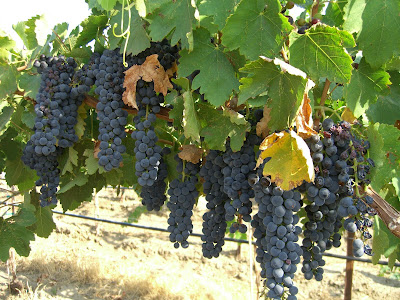
It has been a long time since my last post. Lots of life has happened, but nothing that seemed worthy of subjecting other people to. This summer been an unbelieveably fun episode of mostly hanging out, some traveling, a quick 35 day voyage around the Pacific, and a bit of tending to a small vineyard in the Red Mountain AVA in eastern WA. As far as vineyards go, its been a bad year. We decided we were in over our heads and ripped out a large portion of it. Now we have only a small fraction left, and its scenic and fun and definately not as back-breaking. Maybe someday a billionaire will buy it from us and put in a McMansion winery. If you know of anyone who might be interested, let them know. Yesterday, the weeds and bulldozers were put aside and Christophe and I hauled our buckets down each row to harvest what grapes we could. It was in the mid 80s and a perfect day to pick. Only a few of our plants are bearing fruit this year and we had about 150 lbs of total crop. Harvest is my favorite job during the year of a vineyard's life. Some of the clusters of grapes were dried up raisins, hard as pebbles for some reason, and others had been picked over by the birds. The majority of the clusters however were tight, and full and beautiful. Even with all the mistakes we had made piled on top of each other somehow mother nature prevailed in the end and produced a few thousand perfect berries. There is something about finding a perfect cluster of plump grapes hidden in the lush green vine that feels like finding a bunch of jewels after a long dramatic adventure. Romantic poems come to mind, and the work is pleasing. Classical music trills in your head, even amongst the reports of nearby propane bird guns, and there is an excitement to see what the next plant will yield.


Christophe and I hauled our 25 gallons of grapes to his sister's small winery in the basement where I painstakingly pulled each berry off the stem for a while before losing patience with that process and deciding to stomp them while in the bucket and then pull the loose stems out. We ended up with 12.7 gallons of deeply red must. With Brent's help we added a sulfite mixture that prevents oxidation and retards the growth of the natural yeasts found on the grape skins and in the air. We mixed the sulfur in well and left the must in the fermenter overnight. Our batch of must is about 30% whole berries and 70% crushed. This ratio affects the "fullness" of the wine. 100% whole berry fermentation is common in Beaujolais, and results in a lighter, fruiter wine, whereas crushed berry fermentation results in more of the compounds found in the grape skin entering the wine, tannins, the mythical Reversatrol, and who knows what else. While involved in detail oriented hand destemming I had the sense that I was capturing an entire ecosystem, not just one fruit. When crushing the grapes, everything that lives IN the cluster of grapes goes into the must as well. This idea was a little unpallatable at first, the idea that a nice bottle of wine might acuatlly contain 0.2% crushed spider and spider nests, but after digesting this revelation it merely adds to the mystery of how a bottle of wine, somehow becomes more than just a bottle of wine. Maybe it is those unmentionables and the entirety of a small world that gets captured which helps to produce something more than the sum of its parts.